Proxy
The Proxy page sends njMule's outgoing connections through a proxy, if you need one: a SOCKS 4 or
SOCKS 5 proxy, with or without a user name and password, or an HTTP proxy that allows CONNECT. Most
people need none. The web interface has the same page.
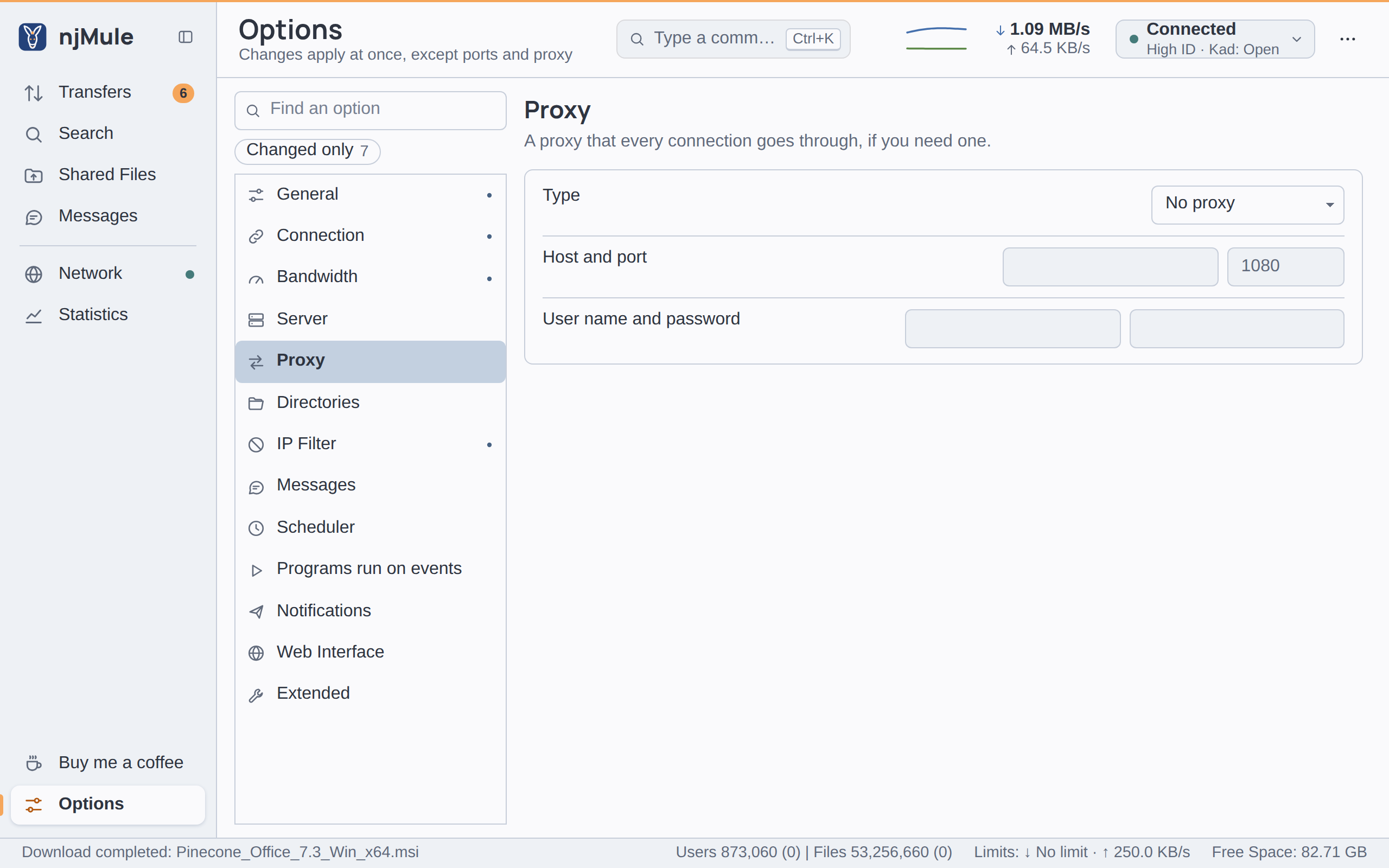
Every option of this page waits for Apply and reconnect (see
When a change applies): njMule then opens its next connections
through the new proxy, without a restart. The proxy is kept in njmule.properties as one setting.
Options
| Option | Default | What it does |
|---|---|---|
| Type | No proxy | No proxy, SOCKS 4 or 5, or HTTP (CONNECT). With No proxy the other fields are off. Its Reset to No proxy link changes the type alone. Key proxy.type: NONE, SOCKS or HTTP. Also in the web interface. |
| Host and port | empty, 1080 | The proxy's host name or IP address, required with a proxy, and its port, a whole number from 1 to 65535. Keys proxy.host and proxy.port. Also in the web interface. |
| User name and password | empty | The credentials of a SOCKS proxy, if it asks for them; leave them empty otherwise. The user name takes up to 255 characters. They go to a SOCKS proxy only, never to an HTTP proxy. Keys proxy.user and proxy.password. Also in the web interface. The stored password is never shown: its field shows dots while one is set, and what you type over them replaces it. |
The password is kept in njmule.properties as you typed it, and never leaves njMule through the
remote-control API.
What goes through the proxy
- TCP connections to servers and clients, and the lists njMule fetches from the web (server lists, IP filter lists, update checks), go through the proxy.
- UDP (server pings, global searches, Kad, messages between clients) goes through the UDP relay of a SOCKS 5 proxy. A proxy that relays no UDP, such as an HTTP or SOCKS 4 proxy, or one that refuses, leaves UDP going straight to the network, and the log says so.
- Connections through routers between firewalled clients are not made behind a proxy, whose relay would show another address.
The proxy carries what njMule sends out; other clients still connect to your own ports. Proxy explains when a proxy helps and what it hides.