Protocol obfuscation
Protocol obfuscation encrypts njMule's connections so that they do not look like eD2K traffic to equipment that inspects it, such as a provider that slows down or blocks file sharing. It is compatible with eMule's obfuscation, so it works with the servers and clients that support it.
Obfuscation is not anonymity. Servers and clients still see your IP address, and the client you exchange a file with knows what it is. It only keeps the traffic from being recognised on the way.
The four modes
Choose the mode in Options → Connection → Network → Protocol obfuscation, in the desktop
app or in the web interface. It applies as soon as it is chosen, to the connections opened from
then on; an eMule profile you import brings its own choice. The preference is
security.obfuscation.
Disabled
njMule never obfuscates what it opens: servers, clients and server datagrams go plain, and clients that require obfuscation are not tried. It still answers clients that connect to it obfuscated.
Supported
njMule tells servers and clients that it can obfuscate, accepts obfuscated connections, and obfuscates its own only towards clients that ask for it. Servers are connected to plainly.
Requested
The default, and the usual setting on the network. njMule obfuscates every connection the other side supports, and still talks plainly with those that do not:
- servers known to take obfuscated connections are tried that way first (those never pinged too, on their main port, and remembered when they accept); only when none accepts is every server tried plainly;
- clients that support obfuscation get an obfuscated connection, the others a plain one.
Required
njMule refuses everything plain:
- plain connections from other clients are refused;
- only clients that support obfuscation, and whose user hash is known, are connected to; the others are neither connected to nor asked to call back;
- only servers that take obfuscated connections are connected to, and global searches go only to servers that take obfuscated UDP.
It costs a lot: many sources and servers become unreachable, the sources servers tell over UDP are not used (they come without the user hash the encryption needs), Kad takes no buddy while you are firewalled (callback requests cannot be obfuscated), NAT traversal is off, and sources are not asked again over IPv6 or through their buddy, which works only plainly.
What each mode does
| Disabled | Supported | Requested | Required | |
|---|---|---|---|---|
| Connections to servers | Plain | Plain | Obfuscated first, plain if none accepts | Obfuscated only |
| Connections from clients | Plain or obfuscated | Plain or obfuscated | Plain or obfuscated | Obfuscated only |
| Connections to clients | Plain; not to those requiring it | Obfuscated if the client asks | Obfuscated if the client supports it | Obfuscated only, to clients that support it |
| UDP to servers (global search, sources) | Plain | Obfuscated where the server takes it | Obfuscated where the server takes it | Only to servers that take it |
| UDP to clients (asking a source again) | Plain | Obfuscated where the client takes it | Obfuscated where the client takes it | Obfuscated only |
Kad obfuscates its own packets with every node recent enough to read them (Kad version 6 and later), whatever the mode; the mode tells other Kad nodes how to connect to you. Server datagrams are obfuscated only when the server gave a key for the address it sees you at, which it does once you are logged in.
Which mode to choose
Keep Requested. It obfuscates almost everything, since most clients and many servers support it, and loses nothing.
Choose Required only if your provider blocks or throttles plain eD2K traffic and you see that it helps; expect fewer sources. Supported and Disabled obfuscate less without any gain for you; they mirror eMule's settings, which an imported profile brings along.
See whether it works
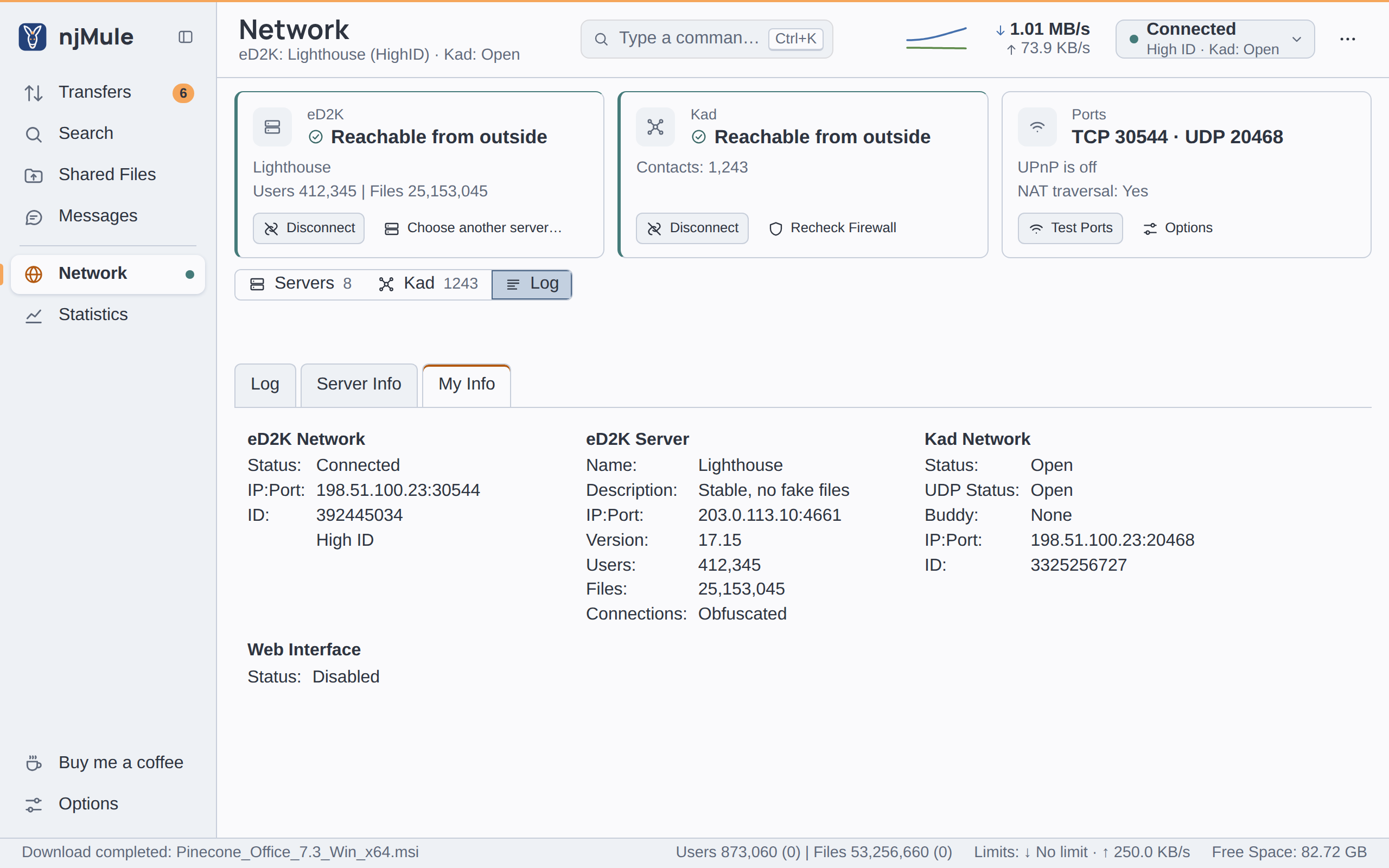
- Network → Log → My Info says, under eD2K Server, Connections: Obfuscated or Normal for the server you are on.
- The server list has an Obfuscation column: whether each server says it takes obfuscated connections.