NAT traversal
A client behind a router or firewall that does not let connections in has a LowID on eD2K and is firewalled on Kad. The networks have long had ways around that, callbacks, but they need one of the two sides to be reachable. njMule adds a way for two firewalled clients to connect through their routers, over QUIC or uTP on the UDP port. It is on by itself whenever it can work; there is nothing to set up.
Callbacks
A callback turns the connection around: the client that cannot be reached is asked to connect to the one that can.
- Through the eD2K server: when you have a HighID and a source with a LowID is on the same server, njMule asks the server, which tells the source to connect to you. With a LowID, it is the other way round: the server tells you that a client wants you, and njMule connects to it and answers its requests over that connection.
- Through Kad: a firewalled Kad source is asked to connect to you through its buddy, or directly over UDP when its UDP port is open. Other clients reach you the same ways while you are firewalled, and njMule's Kad source publishes say which way works.
Callbacks fail when both sides are firewalled: neither can accept the other's connection. That is where NAT traversal comes in.
Two firewalled clients
When you are firewalled yourself (a LowID and firewalled on Kad) and want to download from a firewalled Kad source that has a buddy and takes such connections, njMule meets it through the routers:
- njMule sends a rendezvous request to the source's buddy, which passes it on to the source.
- Both sides send datagrams to each other from their UDP port. Each router, seeing a datagram go out, then lets the answers in: a "hole" opens. Routers that change the port outside are allowed for: the ports near the one expected are tried too.
- njMule opens the connection through the holes, and the eD2K session (file requests, queue, transfer) runs over it as over TCP. A connection that does not open within 25 seconds is given up.
As the source, the same happens the other way: your buddy passes a rendezvous on to you, njMule sends datagrams back and takes the connection from the address the other client was seen at. And while your UDP port is reachable (Kad says UDP open), other clients can open such connections to you directly, even if your TCP port is closed.
QUIC or uTP
- QUIC is used when the other client offers it: the connection is encrypted with TLS 1.3, and each side first proves its user hash before the session starts.
- uTP is the fallback: a reliable stream over UDP with selective acknowledgements and LEDBAT congestion control, which yields to your other traffic.
After a failed QUIC connection with a client, njMule uses uTP with it for two minutes.
Your hello and your Kad publishes tell other clients that you take such connections, only while you do (see below); they follow a change of obfuscation or proxy at once. Only clients that support it can use it; njMule does, so two njMule users behind routers can trade with each other.
What you see
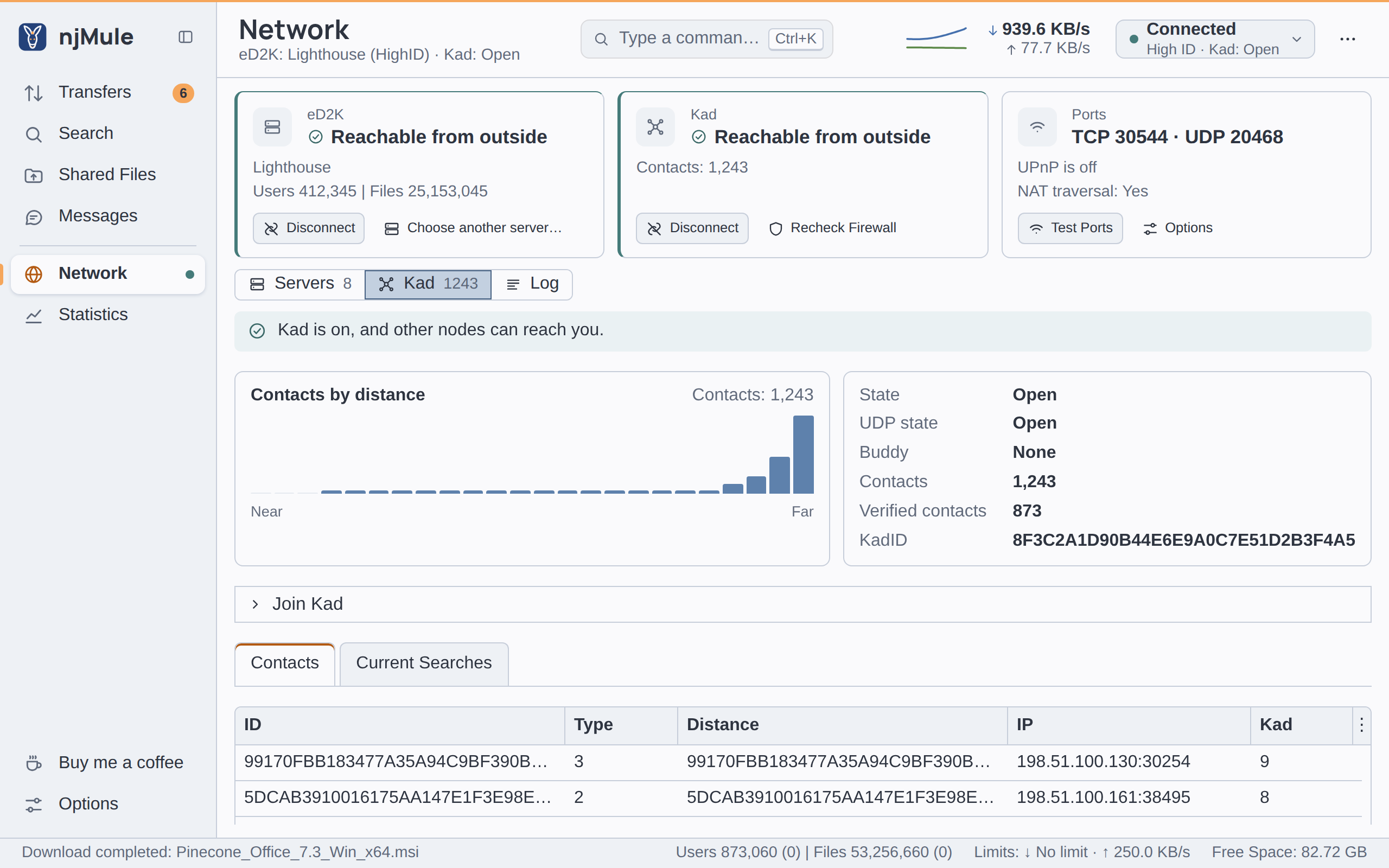
The Ports card at the top of Network, in the desktop app and in the web interface, says NAT traversal: Yes while it can be used, and No otherwise. Sources met this way show in the transfers as any other; nothing else changes.
When it is not used
| Situation | Why |
|---|---|
| Kad is off | The meeting goes through Kad buddies, and the UDP port is Kad's. |
| Obfuscation is Required | These connections are not obfuscated the eD2K way, which Required forbids. |
| A proxy is set | The other client would see the proxy's address, not yours. |
| You are reachable | A plain connection or a callback works, so none is needed. |
Forwarding your ports (see Ports) remains the better fix: a reachable client gets every source, not only those that support NAT traversal.